Welcome to the Wirral Methodist Circuit

Animals of the Bible (9) The Dog

Animals of the Bible (9) The Dog

In the UK, many dogs serve as valuable working animals, and many more are kept as pets and regarded with great affection by their owners. Their companionship has made a great contribution to the happiness and mental health of people at times when Covid-19 restrictions have greatly reduced opportunities for human contact.

Dogs were regarded very differently In the Middle East in Biblical times. Far from being pets, they were semi-wild animals that ran through the streets at night howling and snarling, searching hungrily for scraps, bones and offal. They were detested and despised, an unclean animal to the Jews, and to call a Hebrew a dog was one of the most terrible insults possible. They are referred to 41 times in the Bible, almost without exception in a negative way.

By New Testament times, the word “dog” was often used to refer to Gentiles, and Jesus Himself is recorded as using it in this way in Mark 7 and Matthew 15. A foreign, Gentile woman had come to Him, begging for help for her daughter. The girl, we are told, had an evil spirit or demon in her. She may in fact have had epilepsy, or a mental condition, or another of the illnesses which at the time were attributed to demon possession.

Jesus answered the woman, “Let us first feed the children” (meaning the Jews), “It isn’t right to take the children’s food and throw it to the dogs” (meaning Gentiles). Those words sound harsh to our ears today. Was Jesus thinking aloud, wrestling in His own mind with the prejudices of the society within which He had grown up? Or did He want to teach a lesson to

page1image864596160

His disciples, who clearly regarded the woman as unworthy of help and, as Matthew tells us, had begged Jesus to send her away? Was there a reassuring smile on His face as He spoke to her? What was His tone of voice? We cannot know. What we do know is that He was deeply impressed by the reply she gave Him: “Sir, even the dogs under the table eat the children’s leftovers!”

That was a quick-witted response, but I sense there would have been a note of anguish in the woman’s voice too. Here was a loving mother desperate to see her daughter healed, hoping against hope that this teacher from another country and culture would be able to help her.

Jesus certainly had compassion towards the woman, and did not turn her away. In Matthew’s account of this incident we are told He called her “a woman of great faith”. When she went home she found her daughter had been healed. Jesus had demonstrated that the love of God knows no bounds, and extends to Jews and Gentiles alike; indeed His grace reaches out to all human beings, regardless of nationality, colour or ethnic background – even to you and to me.

A prayer:

We are not worthy even to gather up the crumbs under your table, but it is your nature always to have mercy, and on that we depend. AMEN

(From the Prayer of Humble Access in the Methodist Worship Book, page 196)

– Rev John Barnett
Image: Christ and the Canaanite Woman, Jean-Germain Drouais (1763-1788)
Animals of the Bible (8) The Goat

Animals of the Bible (8) The Goat

In Biblical times, goats were very important as a source of milk, meat, hair and hides. The word “goat” appears 136 times in the Bible, and the word “kid” 51 times. As the word “kid” is now commonly used to refer to a human child, some modern versions use the term “young goat” instead.

Leviticus 16 gives an account of the ceremonies that took place each year on the Day of Atonement. These included casting lots over two goats. One was sacrificed as a sin-offering. The other was released into the wilderness, symbolically carrying away with it the sins of the people. This practice has given us the term “scapegoat” for any unfortunate person who is made to take the blame for the wrongdoings or failings of others.

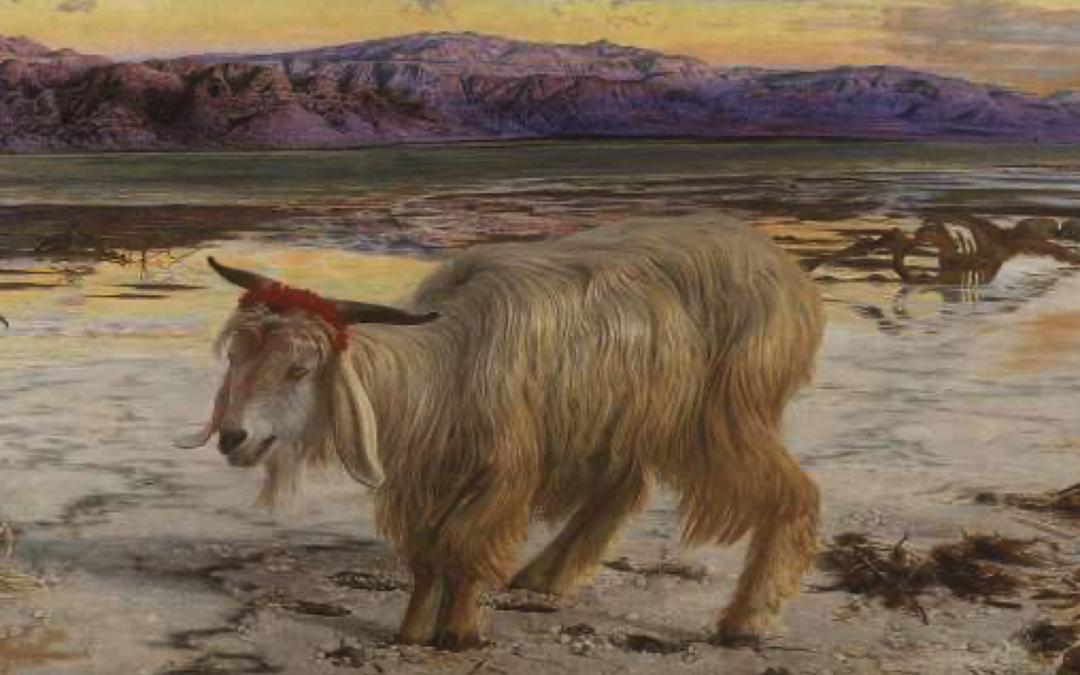
The Lady Lever Art Gallery in Port Sunlight has a striking painting of the scapegoat by Holman Hunt, who depicted the animal as a symbol of Christ, who took upon Himself the sins of the world. The goat in the painting appears hardly able to stand, as if weighed down by the burden of the sins placed upon it. The scarlet thread wound around the goat’s horns, part of the ceremony of the laying on of sins, suggests the crown of thorns.

The frame above the picture bears the words from Isaiah 53: 4, in the Authorised Version: “Surely He hath borne our griefs, and carried our sorrows; yet we did esteem Him stricken, smitten of God, and afflicted.” The desolate background is an actual scene painted by Hunt when he visited the shores of the Dead Sea. Horns and bones lie nearby, the remains of scapegoats of former years.

The poet Robert Graves used similar imagery in his poem “In the Wilderness”. He writes of Christ fasting in the desert surrounded by all manner of creatures, real and mythical, and concludes with these words:

page1image645454928

And ever with Him went,
Of all His wanderings Comrade, with ragged coat, Gaunt ribs – poor innocent – Bleeding foot, burning throat, The guileless old scapegoat; For forty nights and days Followed in Jesus’ ways,

Sure guard behind Him kept, Tears like a lover wept.

A prayer:

O Jesus, crowned with thorns and hailed in derision;
O Jesus, burdened with our sins and the curses of the people;
O Jesus, affronted, outraged, buffeted, overwhelmed with injuries, griefs and humiliations; O Jesus, hanging on the accursed tree, bowing the head, giving up the ghost, have mercy on me, and conform my whole soul to thy holy, humble, suffering Spirit.
(John Wesley, 1703 – 91)

– Rev John Barnett

Image: “The Scapegoat”, Holman Hunt (Lady Lever Art Gallery)

Animals of the Bible (7) The Wild Beasts

Animals of the Bible (7) The Wild Beasts

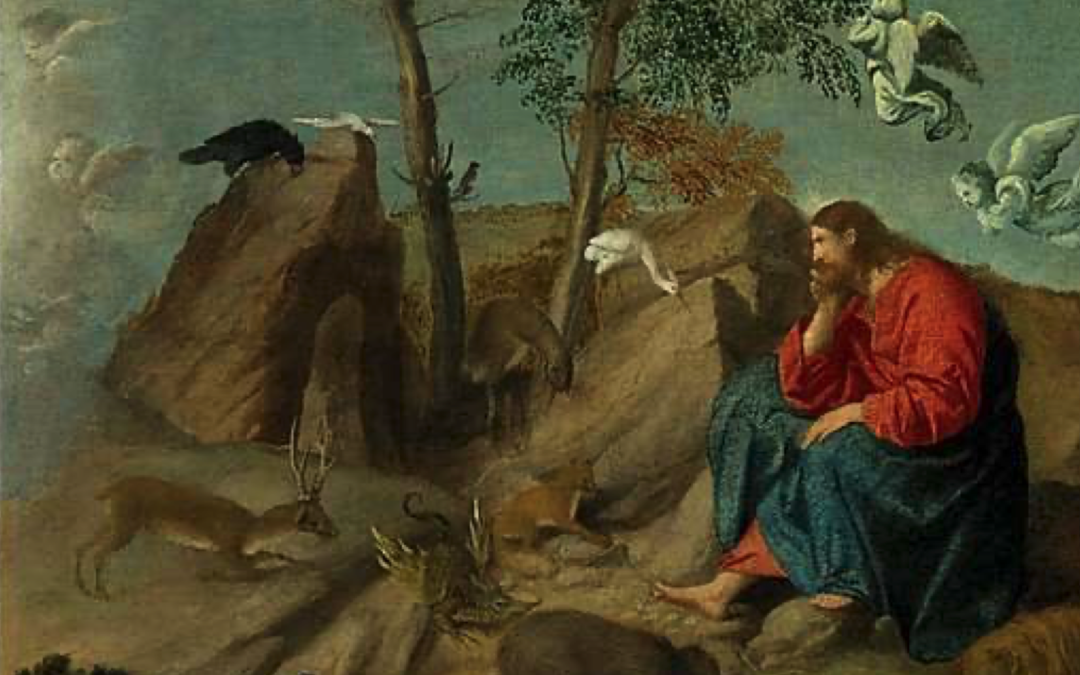
St Mark is not one to waste words, and his account of the temptation of Jesus in the wilderness is much briefer than that of Matthew and Luke. Unlike them, he says nothing about what the temptations faced by our Lord actually were. Nevertheless, he makes a point of telling us that Jesus was “with the wild beasts” (Mark 1: 13).

I have written already in this series about the lions and bears that still roamed the Holy Land in New Testament times. Hyenas, wolves and leopards were also present. A man alone in the wilderness faced the real danger of attack by such predatory animals. Yet Jesus spent forty days and nights among them.

Many commentators connect Mark’s words with Isaiah 11: 6 – 9, which reads thus:

“Wolves and sheep will live together in peace, and leopards will lie down with young goats. Calves and lion cubs will feed together,
and little children will take care of them. Cows and bears will eat together,

and their calves and cubs will lie down in peace.
Lions will eat straw as cattle do.
Even a baby will not be harmed if it plays near a poisonous snake. On Zion, God’s sacred hill,

page1image4100407792

there will be nothing harmful or evil.
The land will be as full of the knowledge of the Lord as the seas are full of water.” (Good News Bible)

This vision of humanity and nature at peace with one another and with themselves is what seems to be in Mark’s mind when he speaks of Jesus living unharmed out among the wild beasts. Isaiah’s words come from a prophecy about a new king in the line of David who will rule with justice and equity. Mark is indicating that Jesus is that long awaited king.

In Romans 8: 18 – 25, St Paul writes of all creation longing to be set free from its slavery to decay and sharing “the glorious freedom of the children of God.” Jesus came to redeem not only the human race but everything God has made, and Paul is looking forward to the time when God’s plan for humanity and all creation is finally made clear, and all things are brought together in Christ (see also Colossians 1: 20).

We join in looking forward to that day, but in the meantime, let us treat our fellow creatures on this earth with kindness and respect. God has a purpose for us all.

A prayer:

Lord, may I love all Thy creation, the whole and every grain of sand in it. May I love every leaf, every ray of Thy light. May I love the animals; Thou hast given them the rudiments of thought and joy untroubled. Let me not trouble it, let me not harass them, let me not deprive them of their happiness, let me not work against Thine intent.

For I acknowledge unto Thee that all is like an ocean, all is flowing and blending, and that to withhold any measure of love from anything in Thy universe is to withhold that same measure from Thee. AMEN

(Adapted from Fyodor Dostoevsky, 1821 – 1881)

Rev John Barnett

Image: Christ with the wild beasts in the wilderness (artist unknown)

Animals of the Bible (6) Apes and Monkeys

Animals of the Bible (6) Apes and Monkeys

Quinquireme of Nineveh from distant Ophir Rowing home to haven in sunny Palestine, With a cargo of ivory,
And apes and peacocks,  Sandalwood, cedarwood and sweet white wine.

I wonder if, like me, you remember reciting in your schooldays those lines from John Masefield’s poem, “Cargoes”? Masefield’s inspiration for that verse came from 1 Kings 10: 22, which in the Authorised Version reads “… once in three years came the navy of Tharshish, bringing gold and silver, ivory, and apes, and peacocks.” The same words are repeated in 2 Chronicles 9: 21, the only other place where apes are referred to in the Bible.

Ophir is mentioned in the same chapters, but nobody is sure where it was. One suggestion is that it was somewhere in India or Sri Lanka. In the Tamil language spoken in both these countries the names for apes, ivory and peacocks are similar to those in Hebrew. It may well be that the people of Solomon’s kingdom imported the names along with the othertreasures. Their ships would have travelled southwards through the Red Sea and eastwards across the Indian Ocean to trade with these lands.

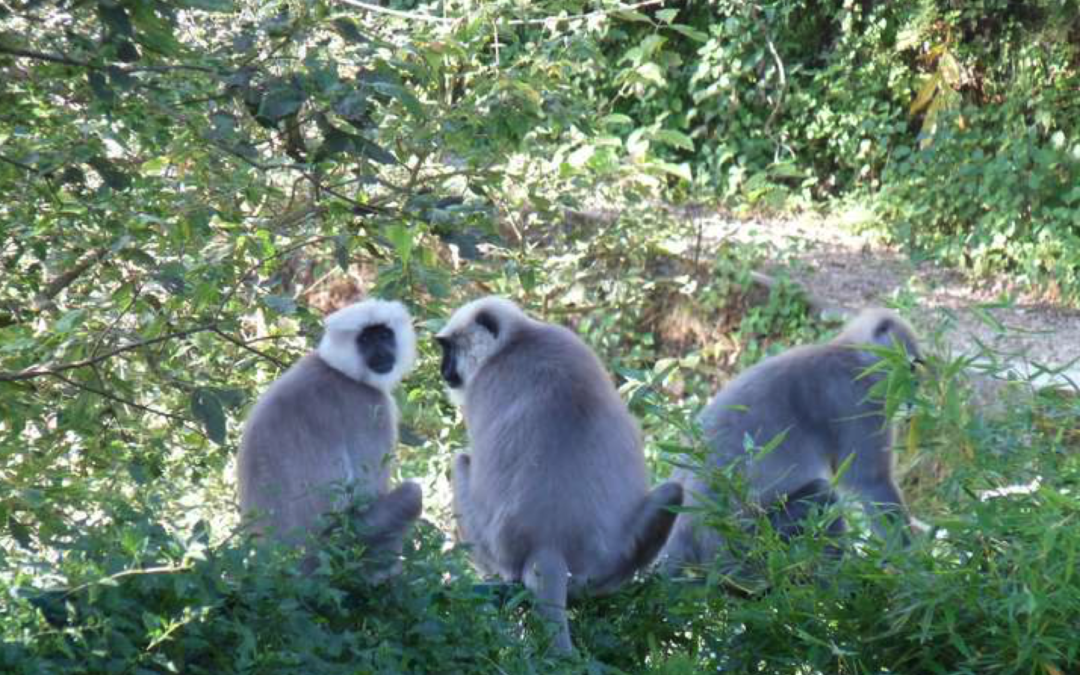
The animals mentioned in 1 Kings and 2 Chronicles were almost certainly not true Asian apes like orangutans or gibbons, but monkeys like the Indian rhesus or langur. Kophim, the

page1image458018704

Hebrew word for “apes” is a general term which also includes monkeys. In fact, some modern translations of the Bible read “apes and monkeys” rather than “apes and peacocks.” Presumably they were brought to be kept as pets or a status symbol for the wealthy. Some people keep exotic animals for similar reasons today.

Neither monkeys nor apes were native to the Biblical lands, but no doubt the Israelites knew of these creatures quite early in their history, for the nearby Egyptians kept several kinds of monkeys. They were clearly prized by their owners, because some have been found mummified. Examination of these mummies has revealed that some suffered from rickets , which is caused by vitamin deficiency. This was no doubt because of the unnatural diets on which they were fed. Others had tuberculosis, the result of being kept in close proximity to humans, and therefore in contact with human diseases.

It is sad when wild animals, particularly highly intelligent primates, are kept as playthings or symbols of wealth. I give thanks for animal rescue centres and for the dedicated people who nurse ill-treated “pets” back to health and, whenever possible, rehabilitate them so they can be released into the wild places where they belong.

A prayer:

Hear our humble prayer, O God,
for our friends the animals,
especially for animals who are suffering;
for any that are hunted or lost or deserted or frightened or hungry; for all that will be put to death.

We entreat for them all Thy mercy and pity,
and for those who deal with them we ask a heart of compassion, and gentle hands and kindly words.

Make us ourselves, to be true friends to animals, and so to share the blessings of the merciful. AMEN

(Albert Schweitzer, 1875-1965)

– Rev John Barnett
Image: Langur monkeys, India (photo: Pete Wildman)

Animals of the Bible (5) – The Red Deer

Animals of the Bible (5) – The Red Deer

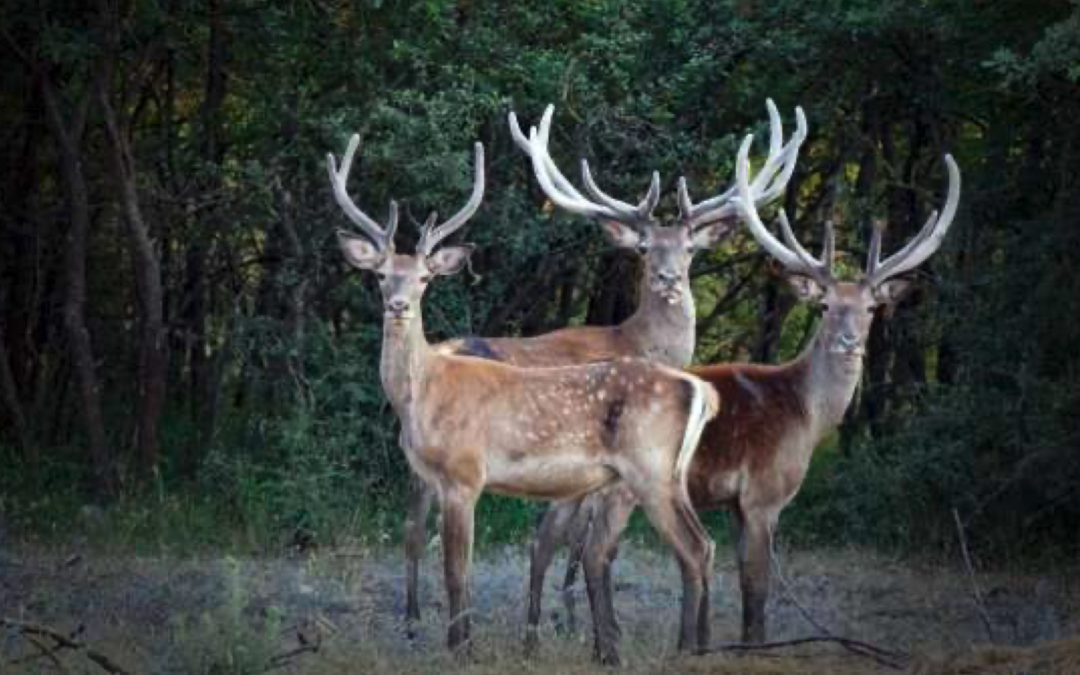
The male Red Deer, called the “hart” in the Authorised Version, is mentioned 11 times in the Bible, and the female, or “hind” 10 times. It seems evident from these references that it was both plentiful and valuable in the Old Testament period. Only the male is referred to as a food item, which is possibly an example of good conservation practice. The females will bear a fawn each year, whilst only a small number of males are needed for breeding purposes. They were regularly on the menu in Solomon’s palace (1 Kings 4: 23)

In the UK today, the Red Deer is most common in Scotland, where there is no lack of water, but in the Middle East water can become scarce in times of drought, and streams can dry up completely. This was in the mind of the writer of Psalm 42, which, in the Good News Bible, begins, “As a deer longs for a stream of cool water, so I long for you, O God. I thirst for you, the living God; when can I go and worship in your presence?” In the original Hebrew the Psalmist uses a word that refers to the bleating sound made by the deer when they were in an agony of thirst during a drought.

Read on in this Psalm and it becomes clear that the writer was longing to worship in the Temple, but was far away from Jerusalem. Maybe he was living during a time of war, or was one of the exiles in Babylon, we cannot be sure. “My heart breaks when I remember the past“, he writes, “when I went with the crowds to the house of God…” (verse 4). Maybe youhave sometimes felt like that when Covid-19 restrictions have kept you from attending your usual place of worship. I was recently listening to a recording of the organ of West Kirby Methodist Church and felt a sudden pang of longing to be back in its familiar surroundings with my fellow worshippers once again.

page1image124557568

Psalms 42 and 43 appear to be two parts of the same Psalm, and there is a refrain that is repeated twice in the former and once in the latter. “Why am I so sad? Why am I so troubled? I will put my hope in God, and once again I will praise Him, my saviour and my God.” Let those words comfort us as we look forward to the time when we can return with our friends to our beloved places of worship. Never forget, though, that God is still with us, here and now, wherever we may be.

A Prayer:

As the deer pants for the water, so my soul longs after you.
You alone are my heart’s desire and I long to worship you.
You alone are my strength, my shield, to you alone may my spirit yield. You alone are my heart’s desire and I long to worship you. AMEN

(Singing the Faith 544, Martin J. Nystrom, b. 1956)

– Rev John Barnett

Image: Hürriyet Daily News, Turkey

=